All blog posts

Brand insight should be continuous and readable at two levels of detail
A brand report that arrives after the decision has little to inform. Why brand data should be continuous, and read in minutes by those who decide and in depth by those who analyse.
Chief Data Officer and Co-founder
· 3 min read
Contents5 sections
A brand study is worth most while the decisions it informs are still open, and a report that arrives weeks after fieldwork often misses them. Continuous brand tracking closes that gap, as long as the same data can be read quickly by the people who decide and in depth by the people who analyse.
The brand research report as a delivery format
For a long time, brand research was delivered as a report of dozens of pages, compiled after fieldwork had closed and presented some weeks later. The format has real strengths, since it carries a considered story and an analyst's judgement about what matters.
Its weakness is timing. The insight is tied to the reporting date, while budgets, campaign plans and positioning choices follow their own calendar. When the report arrives after the plan is set, it confirms or contradicts a decision that has already been taken.
A report also gives every reader the same depth, while readers need different things:
- A leadership team has a few minutes for brand health in a quarterly review.
- An analyst preparing a campaign brief needs the full breakdown by segment, market and competitor.
One document rarely serves both readers well.
What continuous brand tracking changes
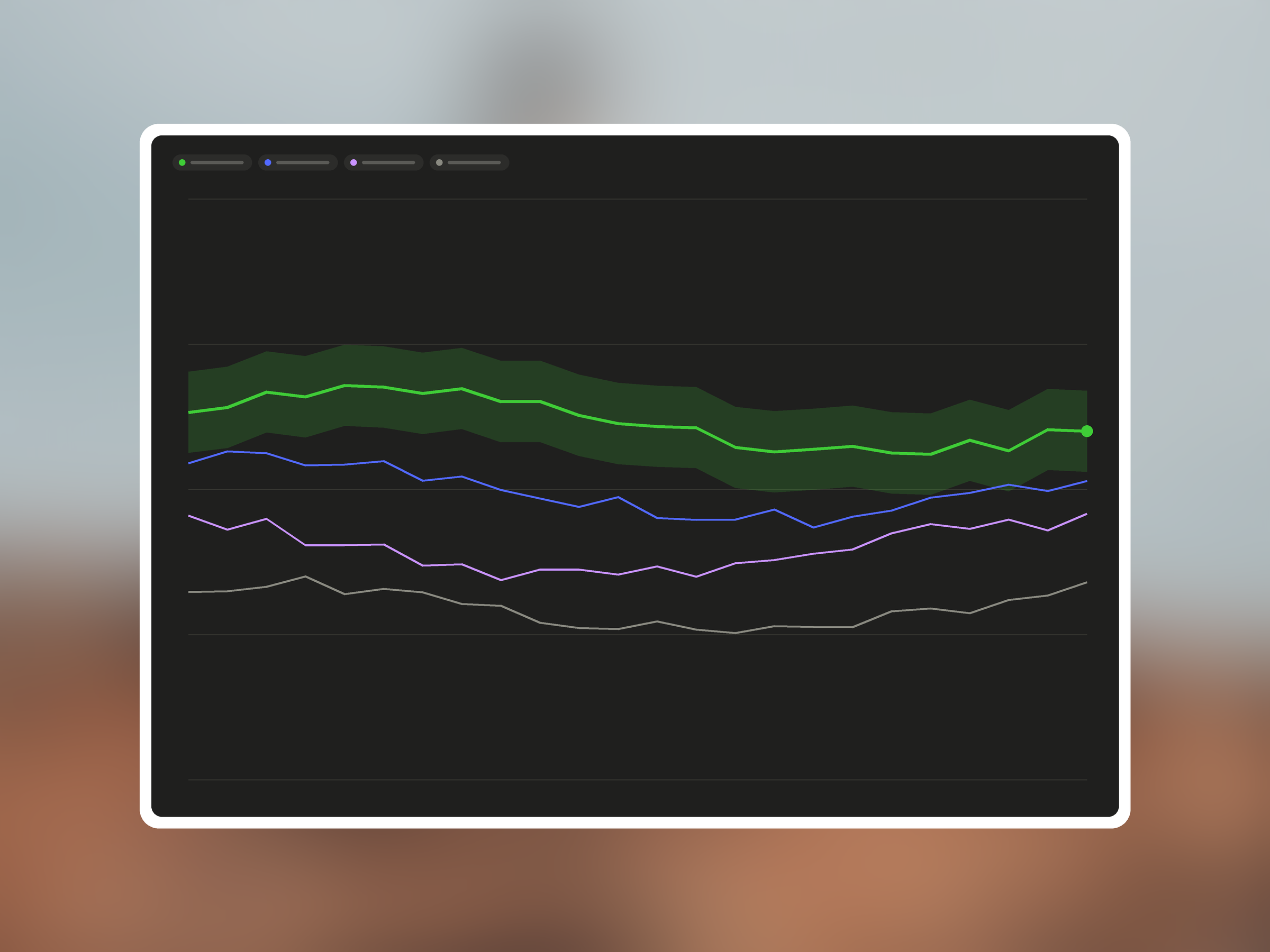
When fieldwork runs every week or month and the data is processed as it arrives, the latest figures already exist when a question comes up. Collection, cleaning, weighting and charting happen in the same flow, instead of taking weeks of manual work between fieldwork and delivery.
The result is a current view of awareness, consideration, perception and loyalty, instead of a picture of the market as it was when fieldwork closed.
Some things stay the same. Every figure is still an estimate with a margin of error, and more frequent data gives more readings without making each one more precise.
At a score of 50%, a reading based on 400 interviews carries a margin of error of about ±5 points, and one based on 100 interviews about ±10. A continuous tracker therefore needs agreed rules for when a movement counts, or every small change becomes a discussion.
Two readers of brand data, one source
Continuous data can be read at two levels:
- The person deciding needs the few measures tied to their decisions, compared with competitors and with the brand's own history, and a clear sign of which changes go beyond normal variation. That should take minutes.
- The person analysing, whether an analyst, a marketer or a communicator, needs the drivers behind those measures: which segments moved, which associations changed, which markets differ, and room to test a hypothesis before it reaches a brief.
Both readings should come from the same data. When the overview and the analysis are built from separate sources, they eventually disagree, and the meeting is spent reconciling numbers instead of deciding what to do.
What makes a brand insight usable
Speed alone does not make a figure useful. In my experience, an insight is ready to act on when it answers the four questions in the table.
Continuous tracking answers the first question best. The other three need method and judgement, and they are where most of the analytical work lies.
How to make brand tracking inform decisions
- Start from the decisions. List the recurring decisions the brand data should inform, such as budget rounds, campaign planning and positioning reviews, with their dates, and plan the reading of the data around them.
- Separate the overview from the analysis, and keep one source. Give the leadership team a short view of the measures tied to its decisions, and give analysts access to the full data behind the same numbers.
- Agree in advance what counts as a change. Set a threshold per measure, based on its margin of error, so that a review spends its time on movements that are real.
- Keep the interpretation. Continuous data does not replace an analyst's reading of it. A regular session where the drivers are explained, for example once a quarter, turns the data into a recommendation.
- Keep the report for what it does well. A considered strategic narrative once or twice a year still has a place, alongside the continuous view.
In most brand work, the constraint is whether the right reading reaches the right person before a decision is made, more than the amount of data. Continuous tracking makes that possible, and it still takes deliberate choices about what each reader sees and when a change counts.
Related product: Odyssey Brand Signal, the brand tracking platform
About the author
Chief Data Officer and Co-founder
Fredrik Augustsson is Chief Data Officer and Co-founder of Odyssey. He is a data scientist with more than 20 years of experience in market and brand research.
More from Fredrik