All blog posts

22% of British beauty buyers want a creative brand, more than twice the German share
Asked to describe the ideal beauty brand, 22% of British buyers say creative and 10% of German buyers. 31% of Germans say timeless, against 19% in the UK, and Nivea leads German facial care with 27%.
Chief Data Officer and Co-founder
· 3 min read
Data
Source. Odyssey Beauty Signal, UK and Germany. Online panel interviews, collected every month and weighted. Consumers aged 16 to 65 who had bought beauty products in the past six months. September 2025 to August 2026: 4,538 interviews in the UK and 4,495 in Germany.
MethodContents4 sections
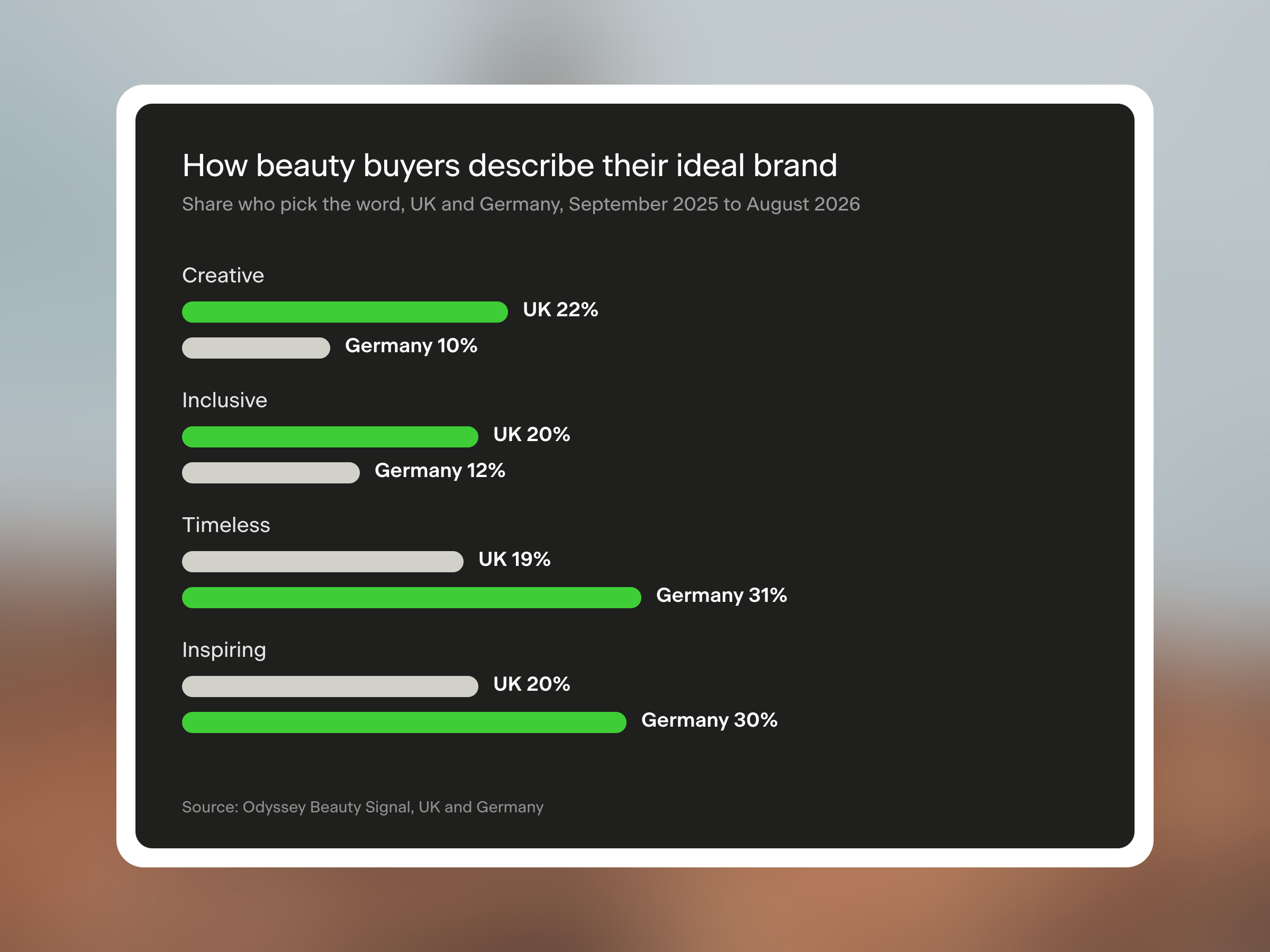
British beauty buyers are more than twice as likely as German buyers to want a creative beauty brand, 22% against 10%. German buyers more often want a timeless brand, 31% against 19% in the UK. The figures come from the same survey question, asked of about 4,500 beauty buyers in each country between September 2025 and August 2026.
Respondents were asked to think about the ideal store or brand that sells beauty products and to choose the words that describe it. The most common answers are similar in both countries:
- Trustworthy, chosen by 50% in the UK and 56% in Germany
- Value for money, chosen by 56% and 60%
- High quality, chosen by 55% and 60%
UK vs Germany: the words that differ most
Creative shows the largest difference between the two countries, and inclusive is chosen by 20% of British buyers against 12% of German buyers.
In the other direction, inspiring is chosen by 30% in Germany and 20% in the UK, and natural ingredients by 34% and 28%.
Creative and timeless by age group
The gap in creative is present in every age group. Among buyers aged 46 to 65, 17% in the UK want a creative brand, about three times the German share of 6%. In Germany the share falls with age, from 17% of 16 to 29-year-olds to 6% of those aged 46 to 65, while the share wanting a timeless brand rises from 27% to 34%.
Nivea leads facial care in both markets, with very different shares
Nivea is the brand German beauty buyers most often prefer for facial care, chosen by 27%. L'Oréal Paris is second with 7%, so Nivea's share is about four times as large. In the UK, Nivea also leads, with 13%, followed by CeraVe and Simple with 7% each.
Among German buyers who rated Nivea, 46% call it traditional and 39% call it timeless. No brand is called timeless more often, and only Kneipp is called traditional as often, at 47%. The brands German buyers most often call trustworthy are Sebamed, chosen by 53% of those who rated it, Dr. Hauschka at 52% and Weleda at 51%.
In the UK, three of the four brands most often preferred for facial care rank in the bottom third on creative. Of 61 brands rated by at least 100 respondents, Simple and Boots rank last and second last, and Nivea 48th. CeraVe, the second most preferred, ranks 23rd.
The brands British buyers most often call creative are less widely known:
- Ilia Beauty is called creative by 49% of those who rated it and is known by 9% of UK beauty buyers.
- Kosas is called creative by 42% and is known by 7%.
- IT Cosmetics is called creative by 37% and is known by 19%.
What it means for beauty brands selling in the UK and Germany
- British brands entering Germany will find fewer buyers asking for a creative or inclusive brand, at 10% and 12%, and more asking for a timeless brand and natural ingredients, at 31% and 34%. In facial care they will compete with a market leader preferred by more than a quarter of buyers.
- German brands entering the UK will find trust, value for money and quality among the most chosen qualities, as at home, and more than twice the German share asking for a creative brand. The facial care market is less concentrated, with no brand preferred by more than 13% of buyers.
- Brands using one brief for both markets can keep the same message on trust, quality and value for money, which are among the most chosen qualities in both. The words that describe the brand's character differ most, so those parts of the brief may need separate versions.
Related product: Odyssey Brand Signal, the brand tracking platform
About the data
Source. Odyssey Beauty Signal, UK and Germany. Online panel interviews, collected every month and weighted. Consumers aged 16 to 65 who had bought beauty products in the past six months. September 2025 to August 2026: 4,538 interviews in the UK and 4,495 in Germany.
Questions. Ideal brand: "If you are thinking about the ideal store or brand that sells beauty products. How would it be?", asked with 21 words describing character and again with 16 practical qualities. Respondents choose any number from each list. Brand preference: "Which of the following brands do you prefer the most, when it comes to these product types?", one brand per product type. Brand associations: "Select all options that you associate with each brand", answered for the brands each respondent rates.
Bases. Brand association shares are based on the respondents who rated each brand. Nivea was rated by 279 respondents in the UK and 291 in Germany. In the UK, Ilia Beauty was rated by 137, Kosas by 134, IT Cosmetics by 261, Simple by 906 and Boots by 992. In Germany, Kneipp, Sebamed, Dr. Hauschka and Weleda were each rated by between 382 and 658. Brands rated by fewer than 100 respondents are left out of the rankings. Age groups: UK 1,674, 1,885 and 864 interviews and Germany 1,441, 1,628 and 1,140 for 16 to 29, 30 to 45 and 46 to 65. The age groups add up to fewer than the totals because some respondents did not state their age.
Differences. The differences between the markets and age groups described in the text are statistically significant at the 95% level, with a margin for the effect of weighting. Differences between individual brands on a single association, such as Nivea, Dr. Hauschka and Kneipp on timeless, are within the margin of error.
AI use. The figures were computed with Odyssey's data engine. An AI assistant helped draft the text, which was checked against the data.
About the author
Chief Data Officer and Co-founder
Fredrik Augustsson is Chief Data Officer and Co-founder of Odyssey. He is a data scientist with more than 20 years of experience in market and brand research.
More from Fredrik