All blog posts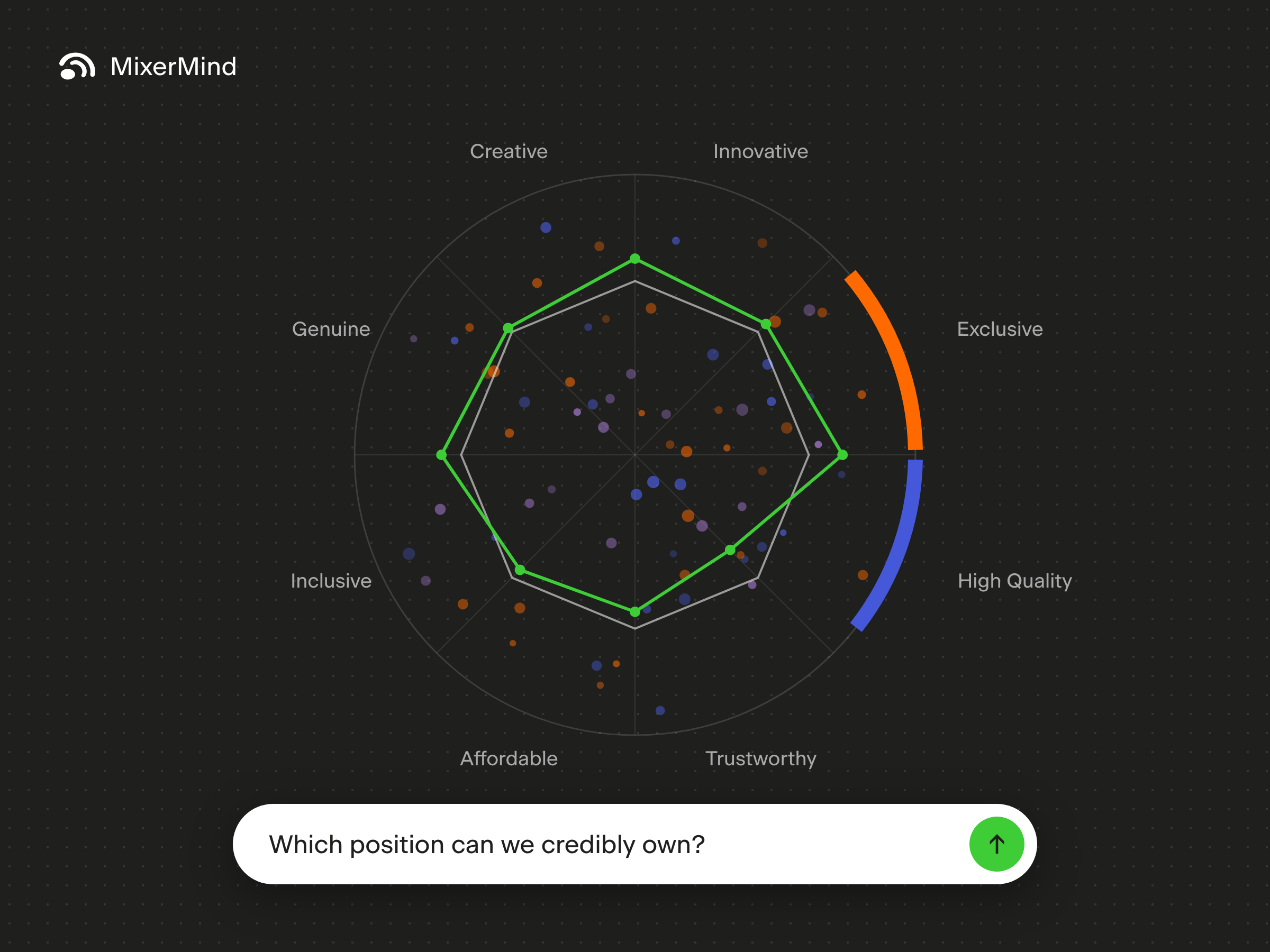
MixerMind: an AI research assistant built into Brand Signal
MixerMind is the AI research assistant in Brand Signal. It answers questions about your brand data in plain language, using the same data and definitions as the dashboard.
· 2 min read
Contents5 sections
Product update · 2 min read
MixerMind is the AI research assistant built into Brand Signal. You ask a question about your brand data in plain language, and it queries the data, presents the result as text, tables or charts, and points out what stands out.
MixerMind is in beta.
What you can ask MixerMind
Questions can be short or open-ended, and can be asked in any language. MixerMind answers in the same language unless asked to use another. Some examples:
- How is our brand awareness developing compared with our competitors?
- What is our current brand strength, and where in the funnel are we strong or weak?
- How do we perform among younger women?
- How does our Share of Attention in Sweden compare with Norway?
- What are our strengths and weaknesses against our main competitors?
MixerMind works from the setup of your Signal: the metrics, brands, competitor set, markets, filters and breakdowns that are available. It builds the query for each question from that setup, so its figures come from the same data and definitions as the dashboard.
How MixerMind answers are checked
Figures about your brand come from queries against your Brand Signal data, and the queries behind an answer can be opened and inspected.
After each answer, a separate AI model checks the figures against the data the queries returned, and the answer is marked with the result of that check.
With web search switched on, MixerMind can add market context such as news, competitor activity and industry reports, with the sources cited.
Answer depth, formats and AI models
- Depth. Answers can be concise, detailed or extensive, and a deeper reasoning mode can be switched on for complex questions.
- Formats. Results come as text, tables and trend charts, and table data can be downloaded.
- Prompt library. Prepared questions, reports and metric templates help new users get started.
- History. Conversations are saved and can be resumed later, with the data reloaded.
- Models. Users can choose between Claude models from Anthropic: Sonnet 5, which is the default, Sonnet 4.6 and Opus 5. The selection changes as new models are evaluated.
- Your own data. Spreadsheets, documents, PDFs and images can be attached to a question and analysed alongside the Signal data. Figures from a file and figures from Brand Signal are kept apart in the answer, and each is labelled with its source.
How MixerMind works, step by step
- Ask a question in your own words and language.
- Follow the progress as MixerMind plans the analysis, queries the data and reads the results.
- Read the result as tables, charts and a short account of what stands out.
- Go deeper with a suggested follow-up question or your own.
- Come back later. Conversations are saved and can be picked up where you left off.
Data security in MixerMind
- Client data is not used to train AI models.
- Data is processed in Google Cloud, and the language models are called through Google Cloud's Vertex AI in EU regions by default.
- Questions and data queries are logged, which gives a record of how each answer was produced.
- Access follows the same login and permissions as the rest of Brand Signal.
Why MixerMind?
MixerMind is a tribute to our late founder, Christer Sjökvist. The name refers to one of his nicknames, and much of Christer's knowledge of brand research has been built into how MixerMind works.
Related product: Odyssey Brand Signal, the brand tracking platform