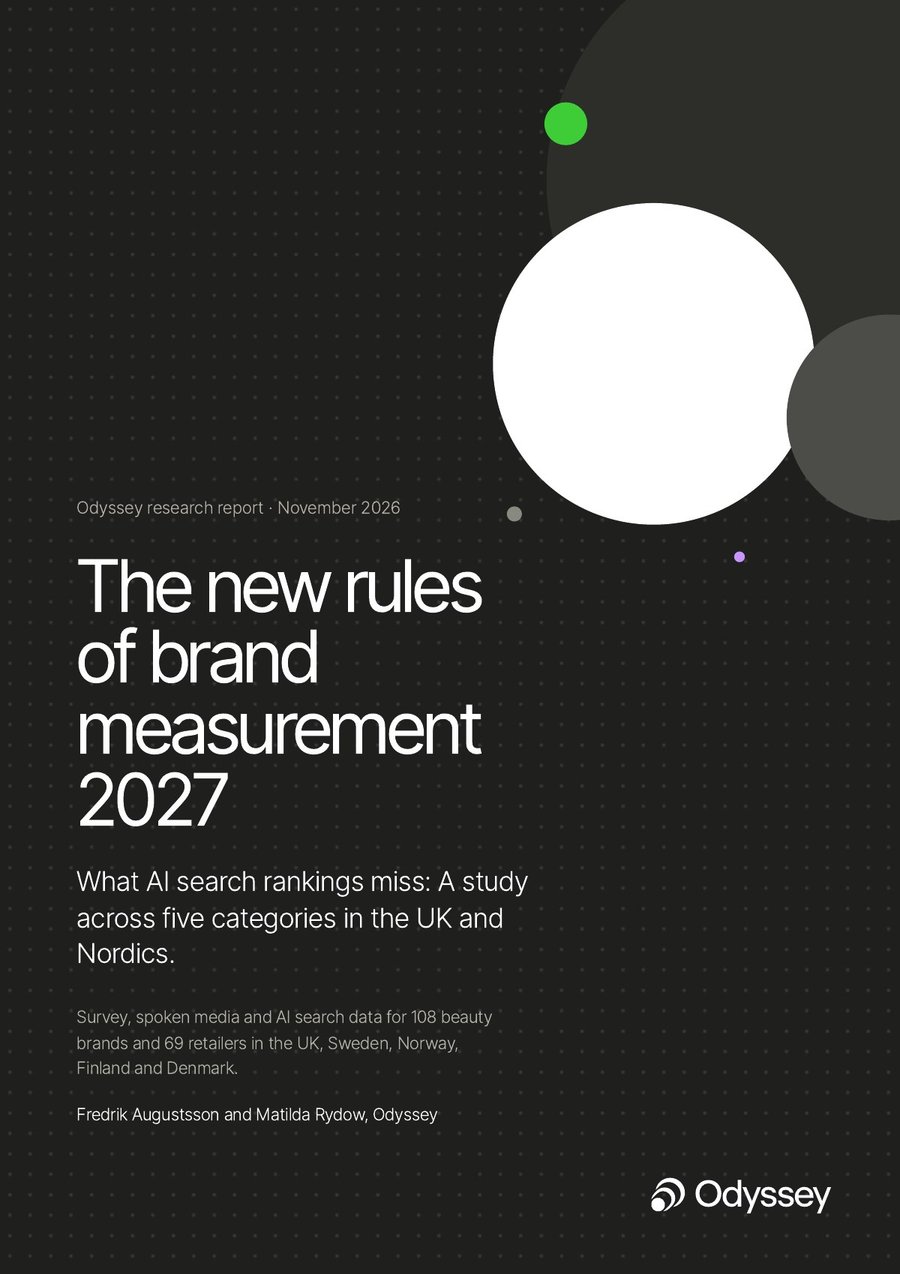
Odyssey research report · November 2026
The new rules of brand measurement 2027
What AI search rankings miss: A study across five categories in the UK and Nordics. Survey, spoken media and AI answers for 108 beauty brands in skin and body care, make-up, perfume and hair care, and for 69 beauty retailers.
Download the report
Free PDF · 51 pages

What AI says about a brand can be very different from what buyers think.
AI answers are becoming another place where shoppers encounter brands. But the brands that appear depend on the needs behind the questions. We compared AI answers with brand research and organic conversation across five markets to see what each source tells us, and what gets missed when they are read separately.
Key findings
Brand shares are counted among the brands we track in each category.

Nivea is the 2nd most named brand in UK AI answers on skin and body care, but 10th on questions about trust
Trust is what UK buyers link most with Nivea. The ranking covers the 56 skin and body care brands we track. Across five markets, 11 of 47 leading brands move three places or more, or are not named at all, when only questions about the need buyers link them with are counted.

CeraVe gets 64% of brand mentions in UK AI answers about trustworthy skincare and is preferred by 6% of buyers who value trust
For Nivea the figures are 1% and 22%. Among buyers who value trust, Nivea is the most preferred brand in four of five markets and level with Dove in the UK. CeraVe leads the AI answers on trust in all five markets, with about half of the mentions in Sweden, Norway and Denmark.

In all 20 categories and markets, AI answers rank brands closer to what people remember and consider than to what they buy
Four categories in five markets. Brands people name without a prompt are the closest match in 13, brands they would consider in the other 7. Recognising a brand from a list is the weakest match in every category.

Five brands get 70% of the first places in UK AI answers on skin and body care
A first place is the first of our 56 tracked brands that an answer names, counted in 311 answers. The five most bought brands have 43% of purchases. Dove, the second most bought brand, comes first in 6.

3 in 4 UK AI answers start with a brand outside the 75 in our survey
964 of 1,290 answers that name a brand. Eight of the ten brands most often named first are missing from the survey list. La Roche-Posay is the most common of them.

When a brand’s own page was on Google’s first page, no AI engine named the brand in 57% of cases
216 of 378 cases in five markets. Each case is one shopping question asked in Google and in five AI search engines.
Nivea is the 2nd most named brand in UK AI answers on skin and body care, but 10th on questions about trust
Trust is what UK buyers link most with Nivea. The ranking covers the 56 skin and body care brands we track. Across five markets, 11 of 47 leading brands move three places or more, or are not named at all, when only questions about the need buyers link them with are counted.
CeraVe gets 64% of brand mentions in UK AI answers about trustworthy skincare and is preferred by 6% of buyers who value trust
For Nivea the figures are 1% and 22%. Among buyers who value trust, Nivea is the most preferred brand in four of five markets and level with Dove in the UK. CeraVe leads the AI answers on trust in all five markets, with about half of the mentions in Sweden, Norway and Denmark.
In all 20 categories and markets, AI answers rank brands closer to what people remember and consider than to what they buy
Four categories in five markets. Brands people name without a prompt are the closest match in 13, brands they would consider in the other 7. Recognising a brand from a list is the weakest match in every category.
Five brands get 70% of the first places in UK AI answers on skin and body care
A first place is the first of our 56 tracked brands that an answer names, counted in 311 answers. The five most bought brands have 43% of purchases. Dove, the second most bought brand, comes first in 6.
3 in 4 UK AI answers start with a brand outside the 75 in our survey
964 of 1,290 answers that name a brand. Eight of the ten brands most often named first are missing from the survey list. La Roche-Posay is the most common of them.
When a brand’s own page was on Google’s first page, no AI engine named the brand in 57% of cases
216 of 378 cases in five markets. Each case is one shopping question asked in Google and in five AI search engines.
Every figure is explained in the full report, with its base and method.
Survey 12 months to Aug 2026 · AI answers Sep and Oct 2026
Learn more in the reportSnapshots from the report
Three sources on one competitor list
Conversation and AI answers are read against the brand survey, which sets the brands, competitors and consumer needs for all three.
The Ordinary: placed in trust by buyers, a value pick in conversation and AI answers
UK skin and body care. Buyers place The Ordinary in Trustworthy, close to the centre of the map. Organic posts mention lowest price 2.8 times as often as for the average brand, and AI answers name it in under 2% of the answers to trust questions.
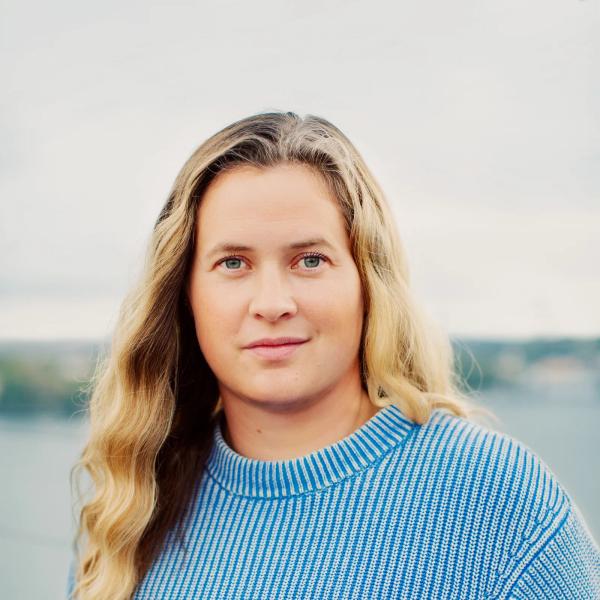
“Whoever chooses the questions still defines the market being measured. Without a grounding in consumer demand and positioning, the ranking tells us as much about the questions someone chose to ask as it does about the brands being measured.”
Matilda Rydow
CCO, Odyssey
How the study was done
Three sources read on the same competitor list: a consumer survey, AI answers and organic conversation.
The study
Five markets
- Survey
- 23,745 people aged 16 to 65 who bought beauty in the past six months, panel weighted. 12 months to August 2026.
- AI answers
- 60 product and 60 retailer questions per market, asked to ChatGPT, Gemini, Copilot, Google AI Mode and Google AI Overviews once in September and four times in October 2026. The same questions were run in Google.
- Conversation
- Posts and episodes on TikTok, YouTube, podcasts and broadcast, monitored by All Ears. January to September 2026 in the Nordics, June to September in the UK.
- Markets and categories
- UK, Sweden, Norway, Finland and Denmark. Perfume, make-up, skin and body care, hair care and beauty retailers: 108 brands and 69 retailers.
- Comparison
- Each brand's share of its category's tracked brands on every measure. Retailers have their own list and their own questions.
For press
Press contact: [email protected]
How to cite: Odyssey (2026). The new rules of brand measurement 2027: What AI search rankings miss. A study across five categories in the UK and Nordics. odysseysignal.com/insights/reports/ai-search-brand-measurement
The report reads survey, spoken media and AI answers on one competitor list. Brand Signal measures them in Perception, Conversations and Visibility, and the beauty data comes from Beauty Signal.
Read the full report
Survey, spoken media and AI answers on one competitor list, with a proposed measurement framework for 2027. Free PDF, 51 pages.